
I am serially having conversation variants that fundamentally center on the different ways people engage technology that enables knowledge work. I am struggling to rectify my thoughts because the capabilities of these systems are accelerating.
My primary observation is people who engage these systems as finished products experience less value than people who engage them as tools that can be used to make other things. I am increasingly curious about how we foster engagement that causes people to treat tools as capable of creating more tools, and sharing what they make and learn. Let’s get weird...and start off with some math.
Compounding Curves
Compound interest is a simple idea: the return in each period applies to the accumulated total, not just the original principal. The result is that growth is multiplicative, not additive. You’ve seen the curve. It looks unremarkable until it does not. I believe this pattern applies to people who employ tools with atypical expectations.
When someone uses a tool, they extract value. When someone uses a tool to build a better tool, they change the base to which all future returns apply. When that better tool is then used to build yet another tool, the compounding accelerates. The person in the second regime isn’t working harder. They’re operating in a structurally different world.
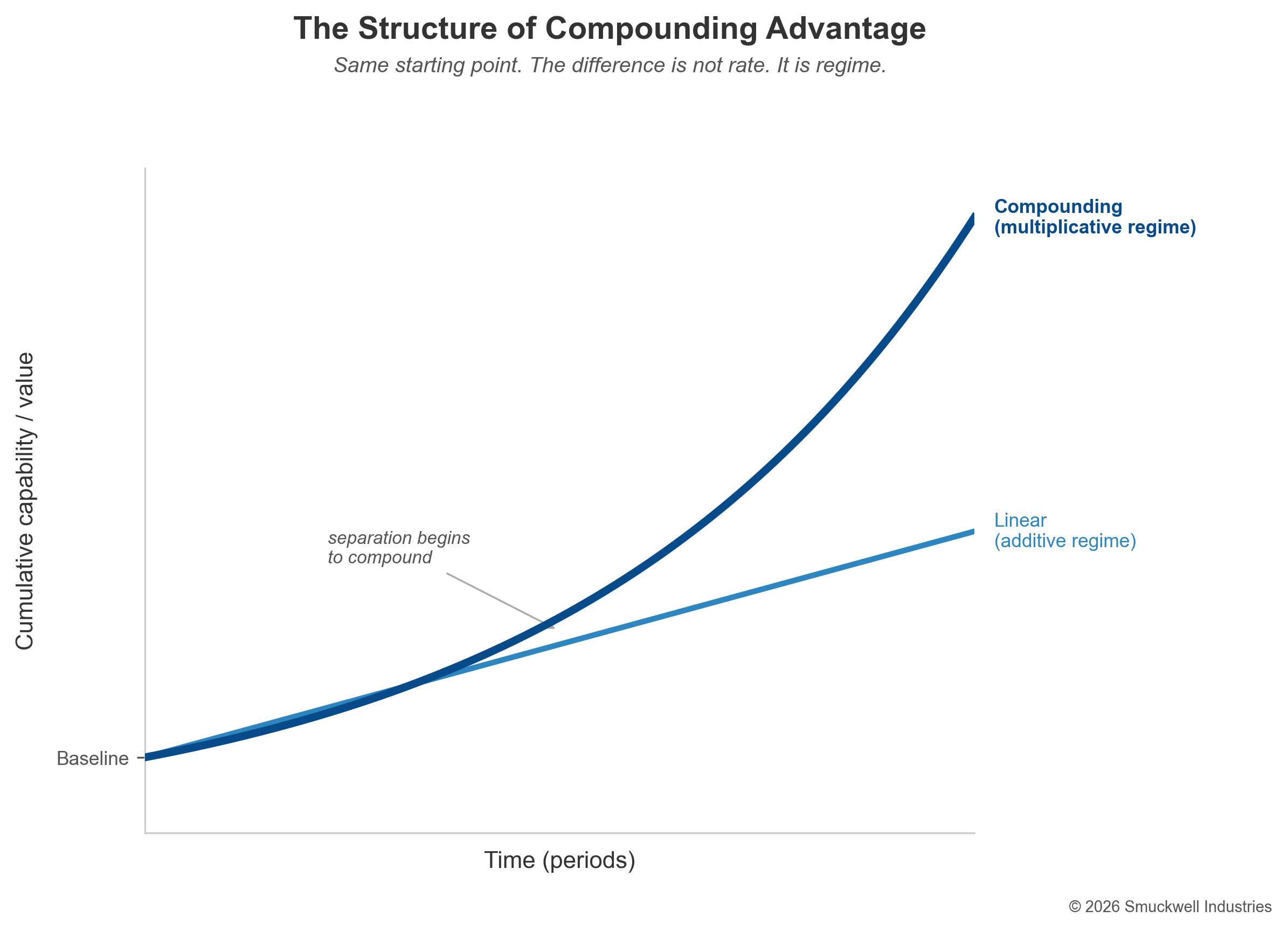
Two curves. Same starting point. The difference isn’t rate. It’s regime. One adds value at a constant pace. The other applies each improvement to the next round of improvement. When the compounding curve separates it moves into a different frame. Some people and some organizations end up in that second curve. The decisions we are making today about how to engage machine intelligence systems project forward with compounding impact. Two key dimensions may be strong path predictors.
Curiosity Depth and Application Breadth Differentiate Outcomes
Before mapping the space with cleaving factors, we need two working definitions.
Substrate engagement describes how deep into the mechanism a person is willing to go. It tends to be high when someone asks “how does this work?” rather than stopping at “does this work?” It tends to be low when a product’s description fully bounds someone’s imagination of its use. Surface engagement means using the tool as packaged. Substrate engagement means treating the tool as a capability surface: something that can be examined, recombined, extended, or used as input to building something else.
Fleet leverage describes the scope of the capability a person creates. It tends to be high when the output of someone’s work raises the ceiling for many others. That looks like workflows, systems, shared infrastructure, and patterns that everyone downstream can use. It tends to be low when the advantage stays personal and local, whether by design or by default.
These two dimensions are independent. You can go deep without sharing. You can share without going deep.
The Archetypes
Mapping these dimensions generates four recognizable modes. This is reductive. It might also be useful.
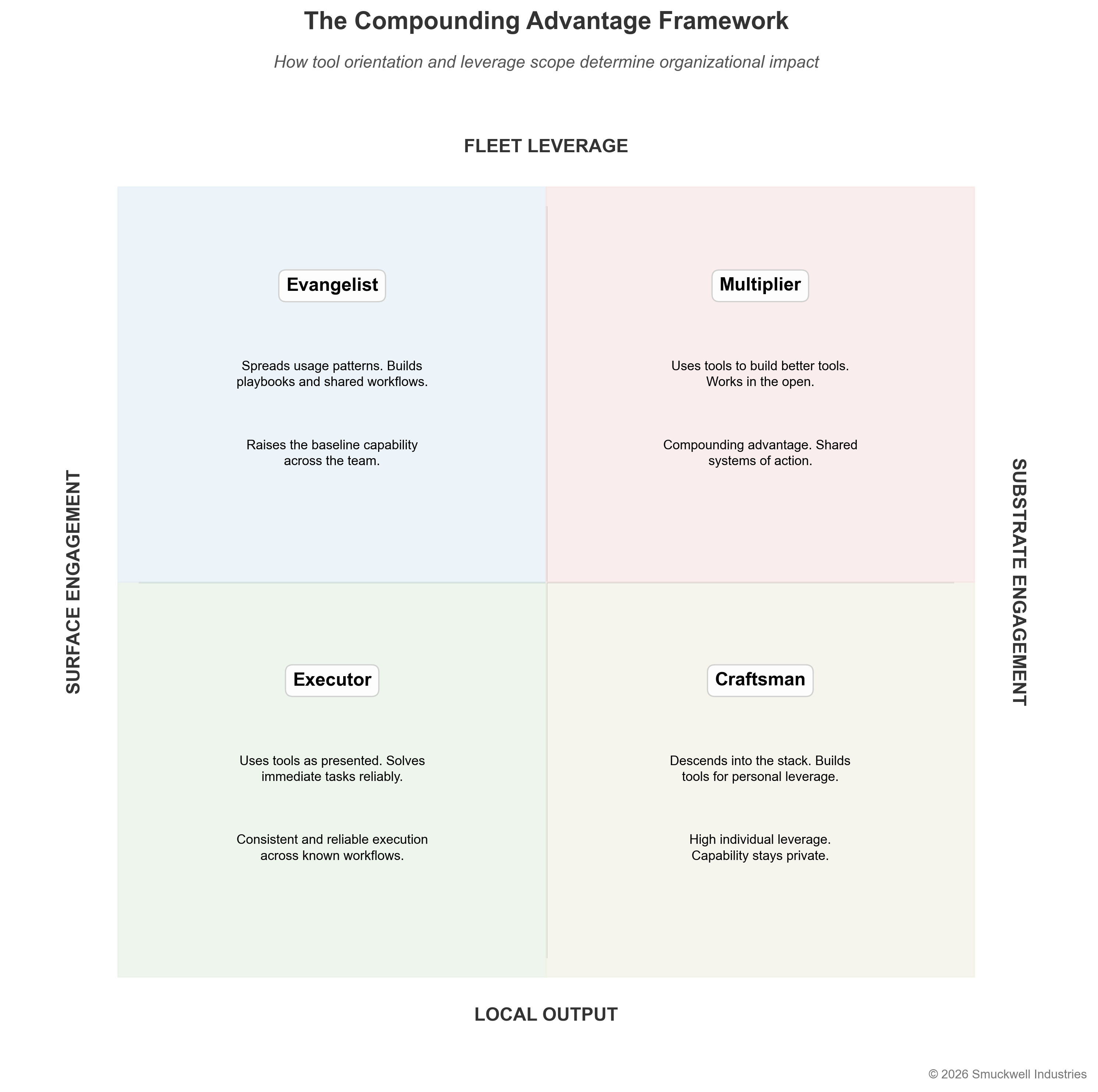
Executors engage at the surface and generate local output. They use available tools as presented, solve immediate tasks reliably, and optimize within the current workflow. This isn’t a criticism. Executors are the operational backbone of any functioning organization. Reliable execution has real value. The risk is that it has a ceiling: the ceiling of the tools available in their current form, used in their current configuration.
Evangelists stay at the surface but build for the fleet. They spread successful usage patterns, build playbooks and prompt libraries, document workflows and share them broadly. Where Executors run the current plays, Evangelists raise the baseline across the team. Their leverage is real, though bounded by the depth of the usage layer they’re operating in.
Craftsmen go substrate-deep but keep it local. They descend into the mechanism, explore primitives, and build custom tools for themselves. They often generate spectacular personal leverage. The risk is that the capability stays private, either because they never thought to share it, because the incentive structure doesn’t reward sharing, or because obscure advantage feels like a feature rather than a bug. High individual output, low fleet multiplier.
Multipliers are the third curve. They go deep and they build for the fleet. They use tools to make better tools, and they make those better tools available to others. They work in the open. They convert insight into shared infrastructure. They treat a clever personal workflow as the first draft of a capability that should belong to everyone. The advantage they generate is genuinely compounding because each improvement becomes the base to which all future improvements apply, across many people rather than one.
Multipliers are rare. Most human capital performance systems are not designed to optimize their contribution because those systems evolved from industrial production functions with low dynamism and highly layered command and control systems. They were not designed to inspire entrepreneurialism.
Where Does the Orientation Come From?
The natural question is whether this is a skills difference or something else. It isn’t primarily a skills difference.
The archetypes above are behavioral expressions of something more fundamental: how rewarding a person finds the act of exploring mechanism, and what kind of environment they’re in when they do it. Both dimensions matter. Neither is fully fixed.
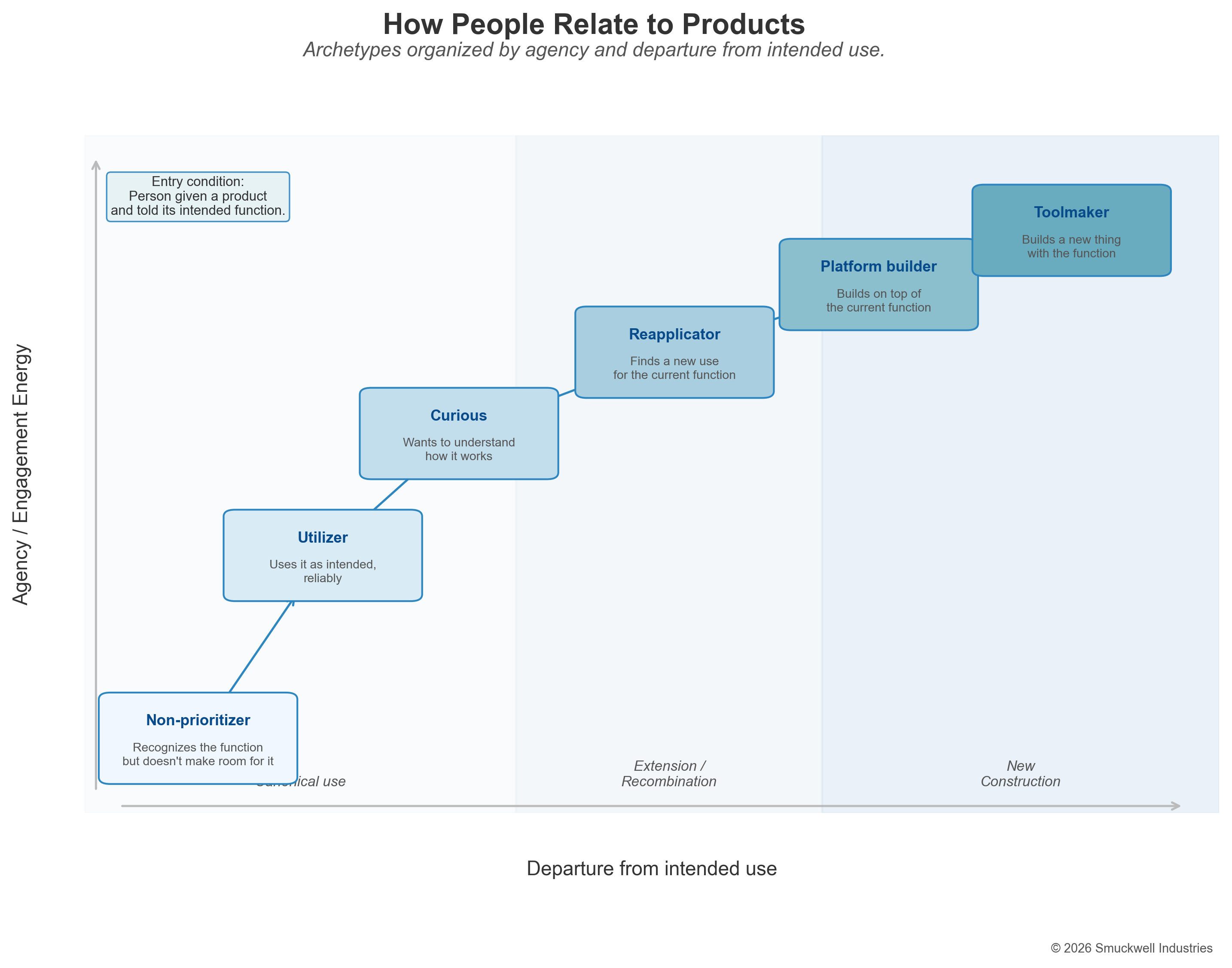
The model here has two underlying drivers. The first is reward profile, specifically, what feels intrinsically motivating: completion and output (finishing tasks), or exploration and mechanism (understanding how things work). Researchers who study this draw on a body of work around epistemic curiosity and intrinsic motivation that traces back at least to Deci and Ryan’s self-determination theory. The short version: some people experience a gap in understanding as rewarding in itself. Others experience it as friction to be resolved as quickly as possible so they can get back to the work. Neither is wrong. They’re different motivational architectures.
The second driver is normative environment: culture, incentives, identity, and permission structures. Whether someone’s curiosity about mechanism gets activated often depends on whether the environment licenses it. Organizations that punish tinkering, penalize broken prototypes, and reward only visible throughput are effectively telling the people with substrate-seeking reward profiles to stop doing the thing that would make the organization most valuable. This happens constantly. It’s not malicious. It’s the predictable output of incentive systems optimized for short-term execution rather than long-term capability creation.
This matters for a reason the framework diagram can’t show: you don’t need to find fully formed Multipliers. You need to create conditions where people with the latent orientation can discover it in themselves. The disposition is more common than the behavior. The suppression is usually environmental.
The archetypes in this map aren’t a skills hierarchy. A Non-prioritizer isn’t deficient. They may simply be in the wrong context for this behavior to matter or activate. A Utilizer isn’t failing to be a Toolmaker. The categories describe a relationship between a person’s motivational profile and a particular product or tool in a particular environment. Change the environment, and some of those categories shift.
One more structural note: the failure response is a modifier, not a peer archetype. Whether someone stops or tries again after friction intersects with all of these categories. A Curious person can become a Skeptic if engagement through friction is punished enough times. A Reapplicator can become Resilient if the culture treats failed experiments as information rather than embarrassment. Persistence under friction is partly individual disposition, partly organizational design.
Things Are Very Different Now
For most of the history of toolmaking, the threshold between using a tool and making one required a significant investment. You needed either deep technical knowledge, meaningful slack time, or both. The path from “I want a better workflow” to “I have a better workflow” was long enough that most people rationally deferred. They waited for a product person somewhere to identify the gap and close it. Machine intelligence has meaningfully lowered that threshold.
This is not the standard “AI makes you faster” claim. The more precise version is: machine intelligence lets people work closer to the material, in the sense that Ryo Lu describes when he contrasts designing in static mocks versus designing in code. The real material of software has always been code, not mockups. The real material of knowledge work has always been structure, logic, and architecture, not finished documents. But operating at the level of material required skills that took years to develop. Now those skills are increasingly available on demand.
What that means for the Compounding Advantage Framework is this: the distance between Executor and Craftsman is shrinking. The gap between “use the tool” and “build a better tool” is lower than it has ever been. People with substrate-seeking reward profiles who previously lacked the technical capability to act on that instinct now have a path.
The old stack (language → runtime → components → operating system → platform → tools → products) was hierarchical. Each layer required significant time investment to master a layer. The new stack is increasingly reproductive: products can generate tools, tools can generate workflows, workflows can generate new products. Moving across layers is faster. This benefits substrate-engaged people disproportionately, because the exploration they were always inclined to do now costs less to pursue.
Not everyone will become a Multiplier, but the fraction of people who can shift into that mode is much larger than organizations typically plan for. And the opportunity cost of not enabling that shift has gone up, because the potential benefit from each Multiplier (measured in fleet leverage and compounding capability) has also gone up with tool creation availability.
Growing Capacity Requires Incentive and Culture Design
Most organizations optimize for run work because this is how they stay afloat. Coordinating and improving work inside an existing possibility set is the hallmark of well run business.
Organizations that optimize exclusively for run work do not engage the frontier that delivers growth. They extract value from the tools they have, seeking capacity rather than capability, until those tools are incapable of delivering the required value growth required. Then they scramble to acquire the growth capability they should have invested in earlier and now need to scale. They over-reward reliable execution and under-recognize the people who change what the system can do next. The cleaving factor here is not technical fluency. It’s whether a person’s work expands the possibility set or operates within it.
Executors and Craftsmen can both operate inside the boundary. The Executor runs the current play. The Craftsman optimizes their personal version of it. Neither changes what the organization can do next. Evangelists and Multipliers both operate at the boundary, but in different ways. The Evangelist lifts the floor, spreading capability that exists. The Multiplier pushes the ceiling, creating capability that didn’t.
Roger Martin has written about organizations as decision factories. In that framing human time, attention, and cognition are the scarce inputs. Better tools make work faster work and preserve scarce human cognition for the work closest to the frontier: classification, judgment, experimentation, and capability creation. Each time a Multiplier converts a clever workflow into shared infrastructure, they’re not just saving time. They’re reallocating the cognitive budget of everyone downstream toward other problems. That’s the compounding mechanism, applied to cognition.
OpenClaw is a rapid prototyping tool, for tools!
OpenClaw is giving us a punctuated experiment of what happens when we give people the ability to build tools, that can build tools.
When people are given a system that can do almost anything, the variation in how they use it is diagnostic. Some solve local tasks. Some create reusable workflows. Some build systems that raise the capability of others. Some hoard advantage and obscure their methods. Some work in the open and treat every clever technique as a contribution to the shared fleet.
None of this is determined by the tool. The tool is neutral with respect to these orientations. What determines it is the interaction of individual reward profile and organizational incentive structure, the same two variables at the base of the relationships-with-products model.
This is why OpenClaw matters as an observation, not just a product. When you distribute generalized agency, you get a natural experiment in organizational culture. The distribution of behaviors you observe isn’t a measure of individual talent. It’s a measure of what your incentive system actually rewards, versus what it says it rewards.
Organizations that want Multipliers need to make fleet leverage visible. They need to reward people not just for throughput, but for the capability they create in others. They need to treat “I built a tool that made ten colleagues faster” as organizationally more significant than “I completed ten tasks.” Currently, most performance systems can’t measure the first thing at all.
Legacy Talent Systems Do Not Multiply Multipliers
Hiring for multipliers is possible but requires different signals. Multipliers don’t primarily show up on resumes as high performers, but Executors who grind existing processes do. Multipliers are people who spontaneously built something to share, who sent the playbook before anyone asked, who treated a good personal solution as the beginning of a shared one. The interview question “tell me about a time you improved a process” is appropriate for a static system context where optimization is sufficient. I prefer “tell me about something you built that other people used.” The answer tells you which quadrant someone lives in.
Developing it requires permission more than training. The capability for substrate engagement is latent in more people than organizations realize. What it needs is license: explicit permission to descend into mechanism, tolerance for broken prototypes, and an incentive structure that treats shared capability creation as strategic work rather than a distraction from real deliverables. This is not about starting an innovation program. It’s about removing the signals that tell substrate-seeking people to stop.
Working in the open is not a personality preference. It’s the mechanism. A Craftsman who goes deep and keeps it local produces excellent personal output. But the organization gets no compounding from that behavior. The transition from Craftsman to Multiplier isn’t primarily about capability. It’s about the decision to treat personal leverage as the prototype for fleet leverage. That decision is shaped by whether the environment makes sharing safe and rewarding.
The Craftsman-to-Multiplier transition is the highest-leverage talent intervention available. You already have the people. The question is whether the system is set up to convert their personal mastery into shared capability, or whether it creates incentives to hoard it.
“Compound/Interest” was not a typo
With the tools available now we have the opportunity to deliver compounding value for our organizations if we spark the interest of people with the ability to bend the curve of our work. The leadership opportunity we have now can radically alter the future returns available in ways we have never seen. In periods of rapid change, when the tools are evolving faster than the documented playbooks, unleashing the Multipliers determines whether an organization extracts the expected value from its capabilities, or the unexpected value of capabilities it didn’t know it could have. The difference between those two outcomes is structural. Understanding it is a starting point. Building for it is the work of leaders, right now.