Defining “Leadership” and “Management”
Management and leadership are both systems of action that involve deciding what needs to be done, creating networks of people and relationships that can address necessary objectives, and making sure the work is done. But they are different activities.
Defining the terms “leadership” and “management” helps use these terms with greater precision. We can use this precision to set appropriate expectations for what good leadership looks like. We draw substantively from John Kotter’s Harvard Business Review article “What Leaders Really Do” to extract concepts that can be used for an analytic framework that focuses on:
· perceiving what is coming;
· understanding interdependencies;
· setting vision;
· effective Communication;
· aligning stakeholders;
· earning credibility;
· inspiring and motivating;
· developing networks; and
· coaching.
We Lead Organizational Change
Leadership focuses on strategic capability. Support that helps our organization adapt for the things we do next. Effectiveness is sustained effort that produces experimentation and learning. What elements describe the work and outcomes of leadership?
· Helping organizations change.
· An inductive process focused on setting direction (vision and mission) and necessary change (strategy) to thrive in a future that differs from the current state. What’s next?
· The work is communicating (receiving and transmitting) and collaborating to analyze trends and synthesize a new approach to adapt to thrive in a future that is dissimilar to the current state.
· Capacity is built upon aligning people who can cascade new direction through the organization so it absorbs and commits to achieving the new strategy.
· Objectives are accomplished with motivation and inspiration that inspire people to keep moving in the right direction and adapt to obstacles.
· Leading change may be expressing what is already well known in a way that inspires people to act because it serves the interests of important constituencies and builds upon strengths and capabilities that can deliver reasonable outcomes.
· Understanding interdependence among uncontrolled/autonomous actors and shaping their collective action with alignment built upon communication.
· Authority comes from demonstrated credibility and is sustained by belief built upon delivered empowerment.
· Motivation is based upon energization that offers achievement.
· Correction is coaching that focuses on direction of outcomes.
· Builds upon informal networks and environments that require high trust for performance.
We Manage Organizational Complexity
Management focuses on operational capability. Support that helps our organization do things we do now. Effectiveness is sustained effort that produces optimization and efficiency. What elements describe the work and outcomes of management?
· Helping organizations manage complexity.
· A deductive process focused on creating order and consistency. What’s missing?
· The work is planning (setting goals and targets), creating actionable steps (operational controls), and budgeting (allocating resources) to adapt to thrive in a future that is like the current state.
· Capacity is built upon creating organizational structure, defining roles, staffing with appropriate talent, communicating the plan, delegating accountabilities, monitoring progress, and correcting performance.
· Objectives are accomplished with control and problem solving that identifies and removes barriers to plan.
· Understanding the features of work delivery among controlled actors and organizing their collective action with structures (incentives, roles, and reporting relationships).
· Authority comes from the role and is sustained by delivering on plan.
· Motivation is based upon compliance that offers safety.
· Correction is instruction that focuses on quality of processes.
· Builds upon formal networks and environments that do not require high trust for performance.
Appendix A-Concept Comparison of Analysis, Management, and Leadership
Business direction builds upon several complementary capabilities that apply different skillsets to advance different phases of the lifecycle of work in dynamic business environments. The figure below summarizes the high-level conceptual objectives of those different phases to compare the different work of analysis, management, and leadership.

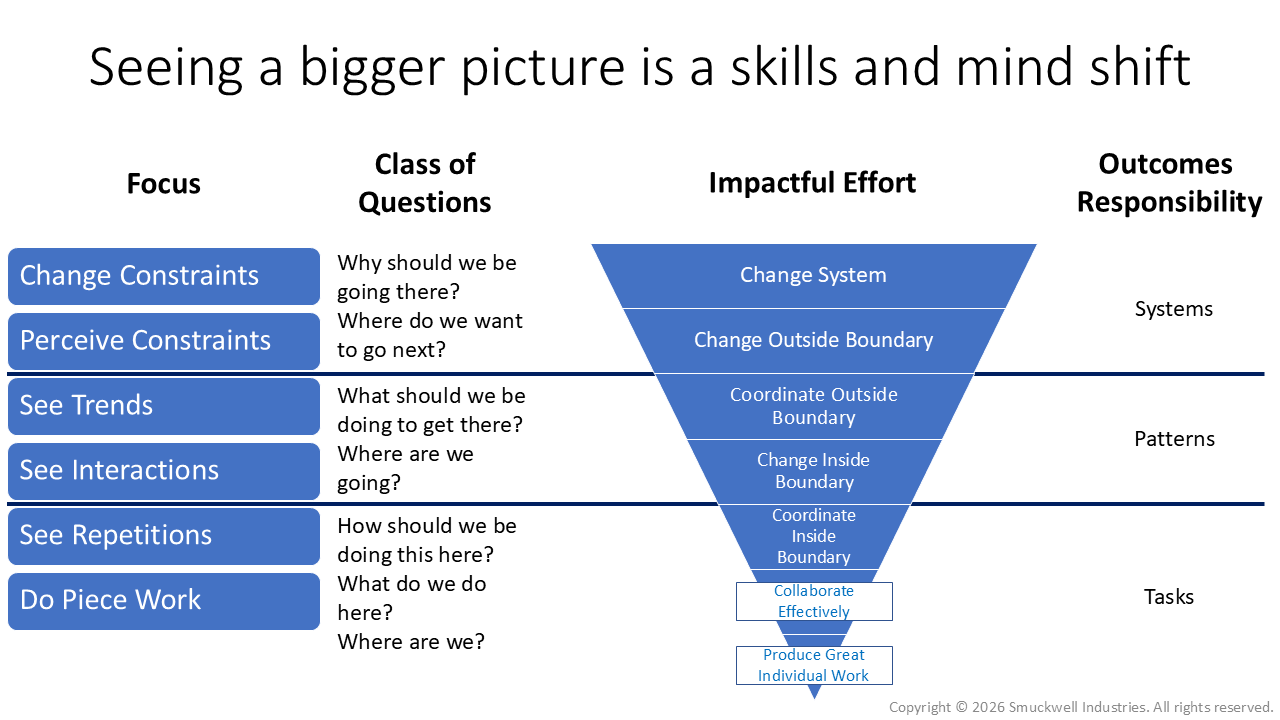
Appendix B-Task, Patterns, and Systems Impact Progression Model