
At dinner last night someone asked me why I left a great job for something new. I tried to articulate what attracted me to the opportunity, and I simplified it to “I wanted a new adventure.” I try to extract the core characteristics of job opportunities into a more formal examination below.
This is my attempt to make career choices less mystical. Instead of arguing about whether a job is “good” or “bad,” I break the job down into the three deals it is actually offering you and then ask a more precise question: which deal am I optimizing right now, and what am I paying for it?
This model applies Cleaving Factors.

The premise
A job is not one thing. It is a bundle of three simultaneous bargains:
Security: How much the role stabilizes life and reduces downside risk.
Status: How much the role confers leverage, access, and narrative power.
Experience: How the work feels day to day, including growth, agency, and meaning.
Most frustration comes from one of these being quietly “off” while the others look great.
The model in one sentence
The Job Deal framework models a role as a point in a 3D space (Security, Status, Experience), and uses three linked 2x2 maps to make that space easy to talk about.
Those three 2x2s are not separate ideas. They are projections of the same underlying 3-space.
The three axes (plain language, operational definitions)
Security
Security is runway and predictability. It is the degree to which your job makes life easier to plan.
Security tends to be high when:
you can absorb a disruption without panic
pay and hours are stable
benefits and protections are real
you could land a comparable role without a heroic scramble
Security tends to be low when:
you are sponsor dependent or budget fragile
income or hours are volatile
a reorg or funding event can wipe you out
re-employment is slow or uncertain
Status
Status is narrative leverage. It is not about ego. It is about access and convertibility.
Status tends to be high when:
your title or brand opens doors without explanation
people seek your input early
you can move resources or decisions
you have a platform (internal or external)
Status tends to be low when:
you are interchangeable
your work is local and invisible
your voice is optional
Experience
Experience is the day-to-day felt reality of the work.
Experience tends to be high when:
you are learning and compounding a craft you care about
you have agency over how the work is done
the people around you are competent and respectful
the work has coherent meaning
you are not chronically depleted
Experience tends to be low when:
you are drained, stagnant, or cynical
your calendar is dominated by intake and rework
you have little agency
the environment is chaotic or political in the worst sense
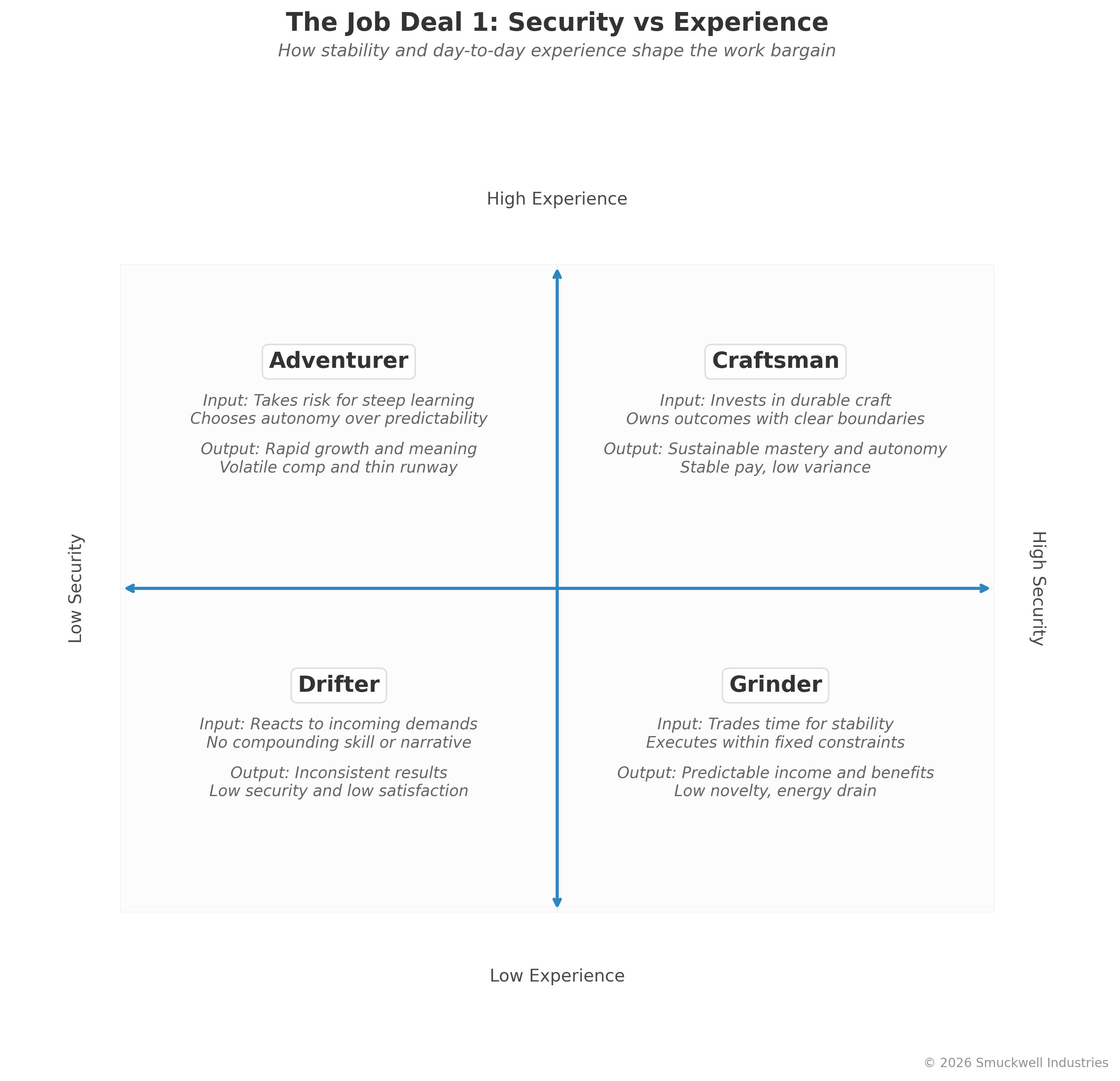
The first map: Security vs Experience
This is the simplest bargain: stability versus how the work feels and compounds.
The four modes:
Adventurer (high experience, low security): learning and meaning, but thin runway and volatility.
Craftsman (high experience, high security): sustainable mastery with stable footing.
Grinder (low experience, high security): predictable life funding, but the work itself is a slog.
Drifter (low experience, low security): reactive work, little compounding, and fragile footing.
If I say “I wanted a new adventure,” I am usually saying: I was willing to trade some Security for higher Experience, at least for a while.
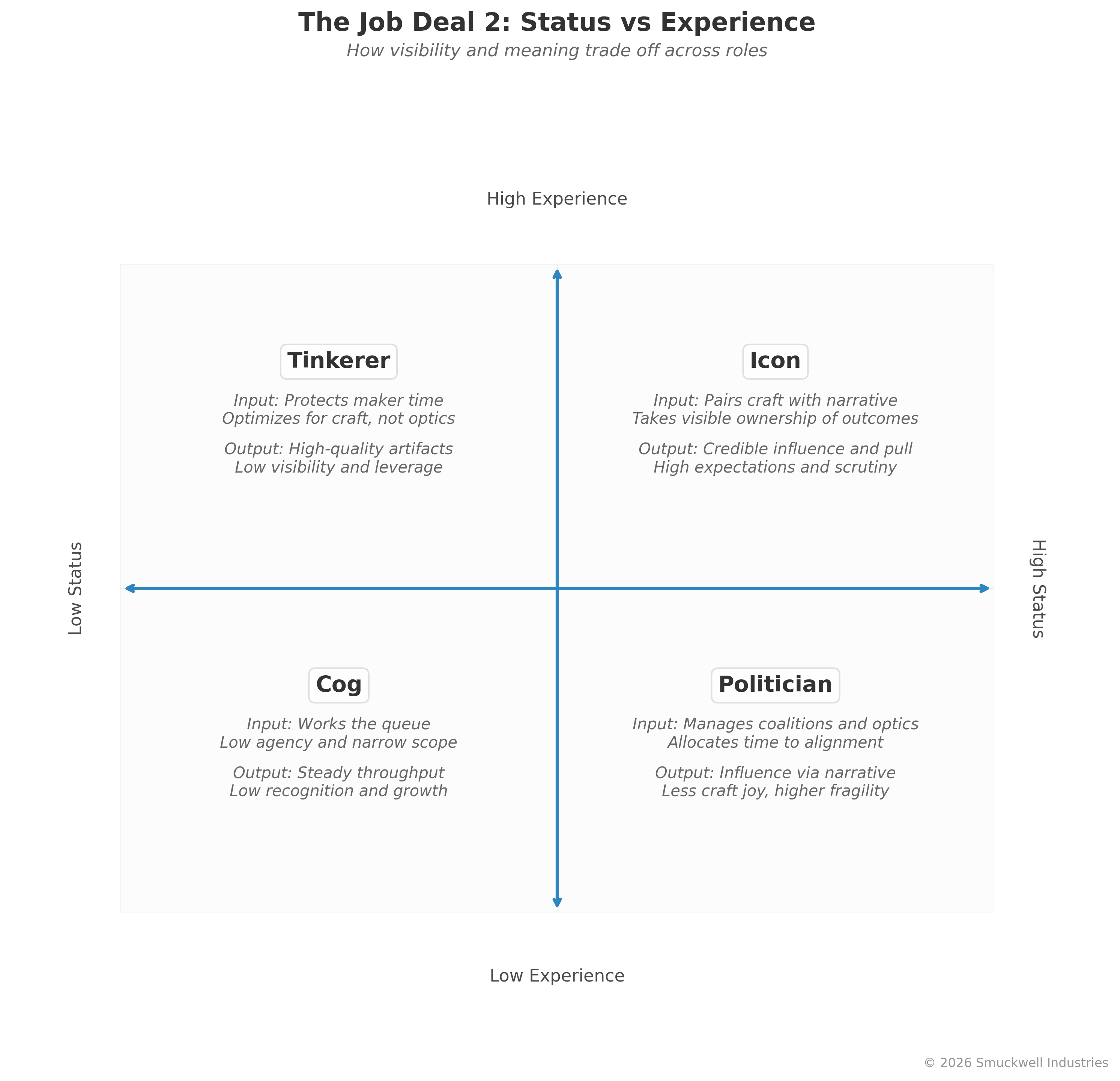
The second map: Status vs Experience
This is the bargain between craft and visibility. It is where many people accidentally drift.
The four modes:
Tinkerer (high experience, low status): deep craft, low visibility, low leverage.
Icon (high experience, high status): craft plus platform, credible influence.
Politician (low experience, high status): coalition and narrative work dominates; craft joy often declines.
Cog (low experience, low status): queue work with low agency and limited recognition.
This map explains a lot of the “I’m successful but unhappy” phenomenon. Status can rise while Experience quietly decays.
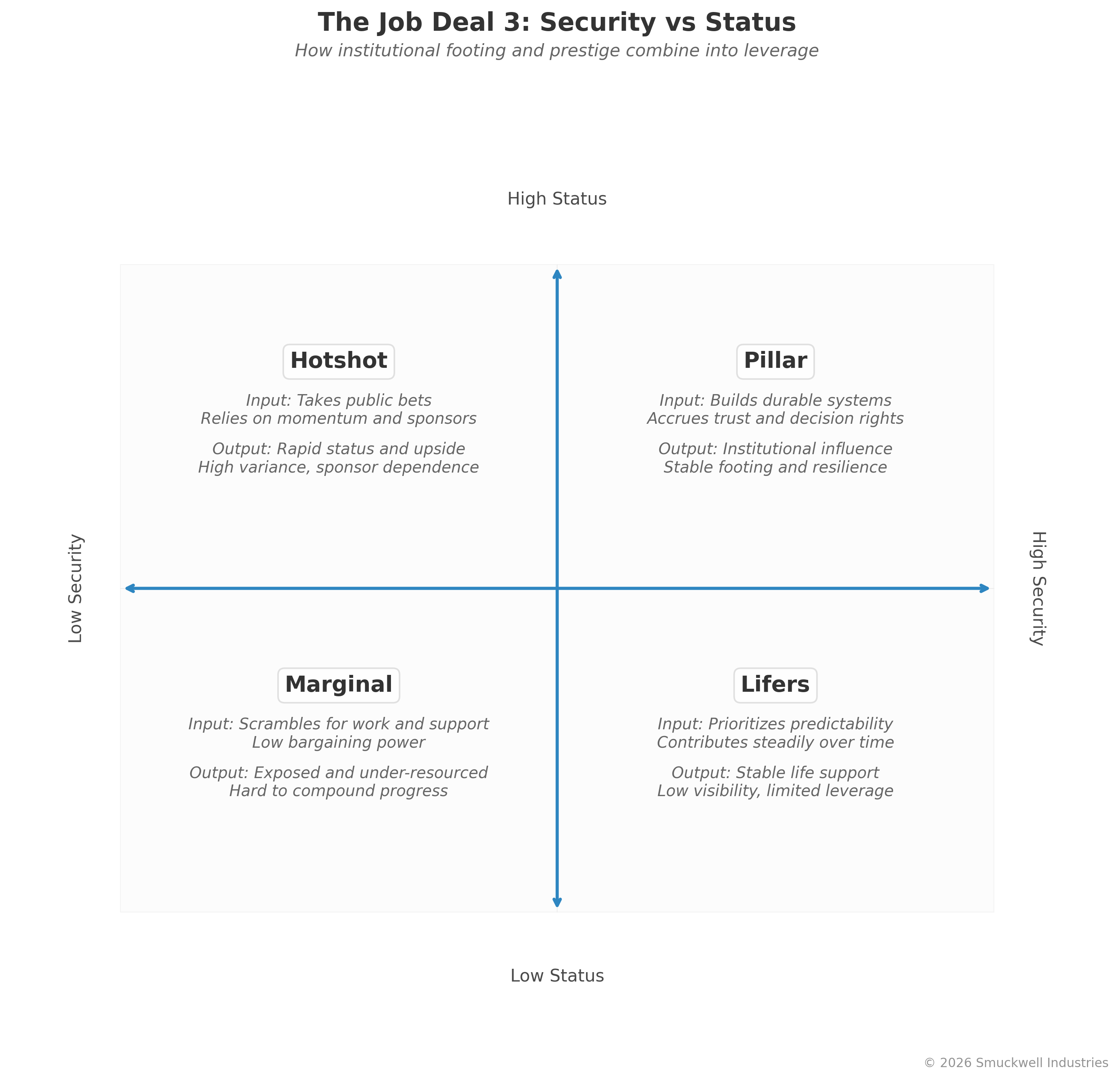
The third map: Security vs Status
This is the bargain between institutional footing and prestige. It is the leverage map.
The four modes:
Hotshot (high status, low security): big upside, sponsor dependence, fragile footing.
Pillar (high status, high security): institutional trust, durable influence.
Lifers (high security, low status): stable and durable, low visibility.
Marginal (low security, low status): exposed, low bargaining power.
This map is useful because many “glamorous” roles are actually Hotshot roles. They can be amazing. They are also easy to misprice.
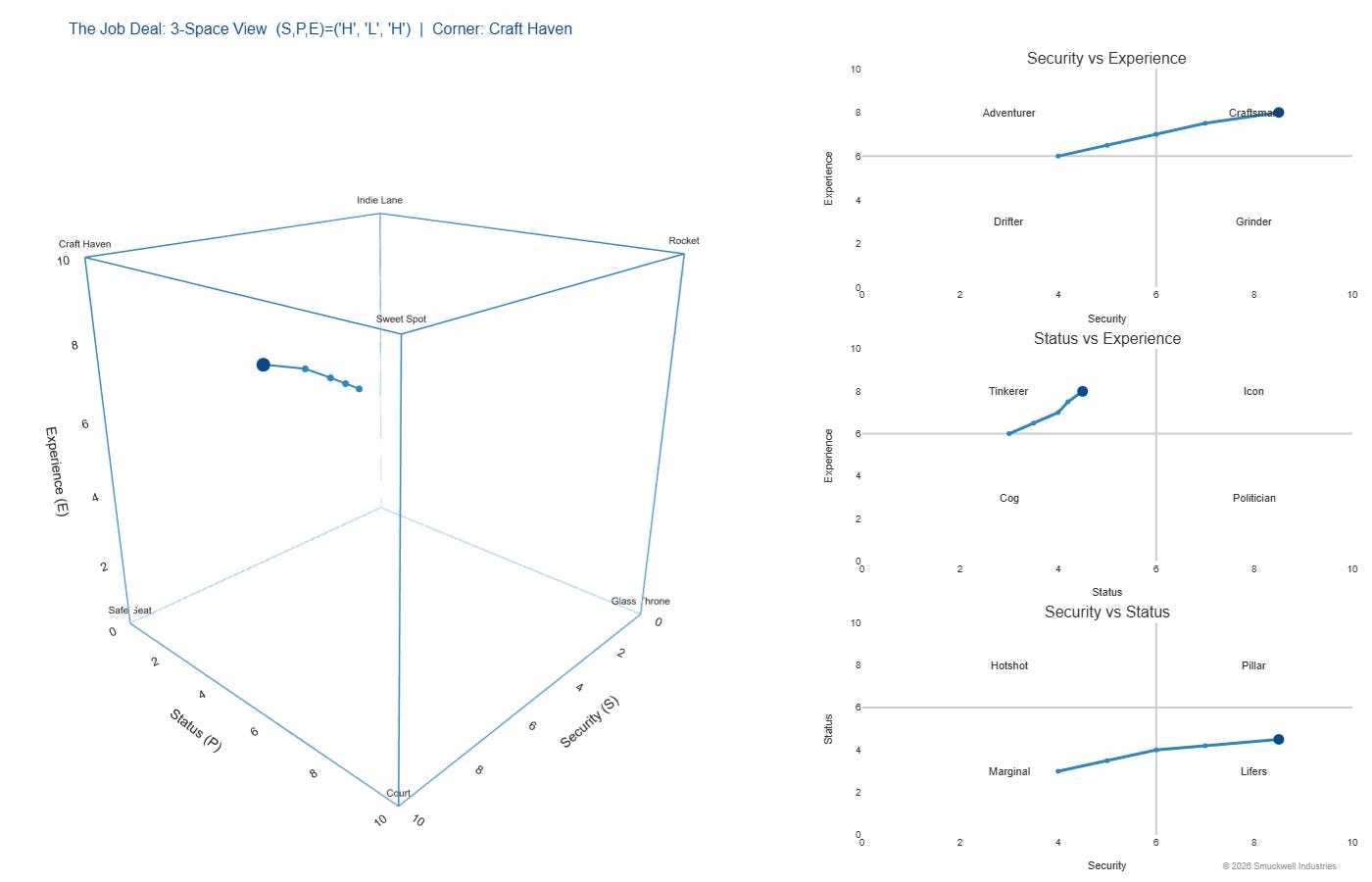
Putting it together: the 3-space view
When you put Security, Status, and Experience together, you get a 3D space. Each job is a coordinate: (S, P, E).
I use two levels of description:
Continuous scores (0–10) for nuance.
High/Low states for fast conversation and quadrant naming.
Those High/Low states create eight “corner” job deals. I name them to describe the role, not the person:
Sweet Spot (H,H,H): meaningful work, real influence, stable footing.
Court (H,H,L): protected influence, low joy, coordination heavy.
Craft Haven (H,L,H): stable craft, low politics, low leverage.
Safe Seat (H,L,L): predictable, low stakes, draining.
Rocket (L,H,H): high meaning and visibility, fragile footing.
Glass Throne (L,H,L): visible but unstable and unfun.
Indie Lane (L,L,H): good work, exposed and under-recognized.
Exposed Corner (L,L,L): low leverage across the board.
You do not need to live at a corner to benefit from the map. Corners just make the shape of the space easy to understand.
Why I split the axes the way I do
If you use simple midpoint thresholds (5/10), labels can flip week to week. Real jobs do not change that fast.
So I treat High/Low as a stable state with a center line (often around 6) that reflects hysteresis: once you are “in” a state, you need more evidence to flip out of it.
In practice, this means:
labels are stable
movement needs to persist
you do not relabel your life based on a single good or bad week
The practical question: which axis is the binding constraint?
A useful rule:
If Security is low or volatile, fix that first. Low security taxes everything.
Else if Experience is low, fix that next. Low experience corrodes sustainability.
Else, if you are blocked from impact by access or resources, invest in Status.
This is not morality. It is constraint management.
Canonical moves (how people actually change jobs)
Most career narratives are a small set of moves repeated in different clothing.
Recraft (raise Experience without blowing up Security)
Example: Grinder → Craftsman
Price: boundaries and political capital
Mechanism: shift from intake to ownership, protect maker time, increase learning rate
Make it legible (raise Status while preserving Experience)
Example: Tinkerer → Icon
Price: visibility tax
Mechanism: publish artifacts, take visible ownership, build a platform tied to outcomes
Institutionalize (convert Status into durable Security)
Example: Hotshot → Pillar
Price: less upside convexity, more constraints
Mechanism: diversify sponsors, formalize decision rights, attach to durable systems
Stabilize (raise Security first)
Example: Drifter → Grinder
Price: less novelty for a period
Mechanism: horizon, predictability, and downside coverage
The main failure mode: drift
If you do not name the trade, the trade happens anyway.
Three common drifts:
Icon → Politician: visibility tax consumes craft time.
Craftsman → Grinder: stagnation or overload erodes experience.
Hotshot → Marginal: sponsor dependence breaks and status collapses.
The antidote is operational guardrails:
maker time floors
meeting caps
artifact cadence tied to outcomes
sponsor diversification
runway thresholds
learning cadence
A closing note on “adventure”
Adventure is not reckless. It is an explicit trade: more growth and meaning, paid for with more variance and less predictability. Sometimes that is the right move.
The point of this framework is not to push anyone toward one corner of the space. It is to help you make the trade consciously, and to give you language that is more accurate than “I just needed a change.”